
Edge's News: Haiti Gang Demands $17 Million to Release US and Canadian Missionaries

A notorious Haitian gang accused of abducting 17 missionaries, most of them Americans, demanded $17 million in ransom for the kidnapped individuals’ release, according to multiple reports.
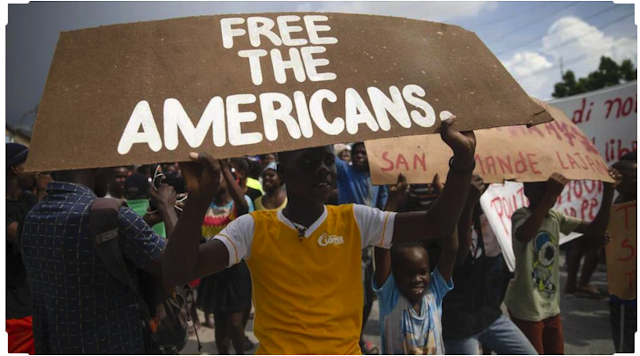

Haitian Justice Minister Liszt Quitel said the gang dubbed “400 Mawozo” demands $1 million per person in order to set the missionaries free, the Wall Street Journal reported, which quoted Quitel as saying.


The gang kidnapped the group—seven women, five men, five children, all U.S. citizens except one Canadian—on Oct. 16 in Ganthier, a commune that lies east of the capital of Port-au-Prince, Haitian police inspector Frantz Champagne told The Associated Press.


The missionaries were on their way home from building an orphanage when the incident occurred, Ohio-based Christian Aid Ministries said in a message. The ages of the abducted children reportedly range between just 8 months and 15 years. The missionaries are affiliated with the Christian Aid Ministries.


White House press secretary Jen Psaki said during a press briefing on Monday that the U.S. government is helping with the rescue efforts.


“The FBI is part of a coordinated U.S. government effort to get the U.S. citizens involved to safety,” Psaki said. “Due to operational considerations, we’re not going to go into too much detail on that, but can confirm their engagement.”


Psaki noted that President Joe Biden also had been briefed on the audacious abduction and is receiving regular updates on the investigation conducted by FBI and U.S. State Department officials to bring the missionaries back home safely.


In recent years, the Oct. 16 abduction is the largest reported incident of its kind in the Caribbean country, with Haitian gangs growing more brazen and abductions spiking as the country is attempting to recover from a magnitude 7.2 earthquake that struck southern Haiti on Aug. 14 and killed more than 2,200 people.


In April, a man who claimed to be the gang’s leader told a radio station that it was responsible for abducting five priests, two nuns, and three relatives of one of the priests that month. They were all later released again.


At least 328 kidnappings were reported to Haiti’s National Police in the first eight months of 2021, compared with a total of 234 for all of 2020, said a report last month by the United Nations Integrated Office in Haiti.


The Department of State currently lists Haiti as a “do not travel” country, noting high crime, kidnappings, civil unrest, and COVID-19.


“Kidnapping is widespread and victims regularly include U.S. citizens,” the agency warns on its website. “Kidnappers may use sophisticated planning or take advantage of unplanned opportunities, and even convoys have been attacked.


“Kidnapping cases often involve ransom negotiations and U.S. citizen victims have been physically harmed during kidnappings. Victim’s families have paid thousands of dollars to rescue their family members.”


Comments

Popular posts from this blog

The FCT Minister–Soldier Standoff: A Test of Civil Authority and the Rule of Law

On November 11, 2025, Nigerians watched in disbelief as a video surfaced showing a tense confrontation between the Minister of the Federal Capital Territory, Nyesom Wike, and a group of armed soldiers who blocked his convoy from accessing a disputed piece of land in Gaduwa, Abuja. The incident, brief but dramatic, was more than a moment of political theatre. It struck at the heart of a much bigger issue — the place of the military in a democracy, and the sanctity of civilian authority under the Nigerian Constitution. The Legal Position: Who Was Right? The Minister’s Authority Under Section 302 of the 1999 Constitution and the FCT Act , the Minister of the Federal Capital Territory exercises the executive powers of the President within Abuja. That means the Minister is not just a political appointee — he represents federal executive authority . His duties include overseeing land allocation, urban planning, and the enforcement of development control through the Federal Capital T...

Nigeria: On the Right of Self-Defence and Protection of National Sovereignty

The Federal Republic of Nigeria reaffirms its unwavering commitment to the purposes and principles of the Charter of the United Nations, in particular the maintenance of international peace and security, the respect for the sovereignty and political independence of all States, and the peaceful settlement of disputes. Nigeria is a sovereign and independent nation. Our Constitution vests sovereignty in the people of Nigeria and mandates the Government to protect the territorial integrity and independence of our country. This sovereignty—recognised under international law and reaffirmed by our membership in the United Nations, the African Union, and the Economic Community of West African States (ECOWAS)—is inviolable. The Government of Nigeria has observed with grave concern recent statements and actions that amount to a threat of aggression and possible violation of our territorial integrity. We remind all States that any such threat or use of force contravenes Article 2(4) of the Ch...

Kebbi’s 3 a.m. Withdrawal Shows Why President Tinubu’s Security Reforms Can’t Wait

When Governor Nasir Idris of Kebbi State revealed that security personnel deployed to vulnerable communities were withdrawn at 3:00 a.m.—just 45 minutes before an attack—Nigerians reacted with shock, anger, and a single question that refuses to disappear: Who gave the withdrawal order? It is a fair question. It is also one that may take time, investigation, and institutional honesty to answer. But the Kebbi incident exposes a deeper truth about security management in Nigeria: our command structure is too fragmented for a country battling multi-layered threats. And this, more than anything, validates President Bola Ahmed Tinubu’s push for a centralised, technology-driven, and accountable security coordination model. Nigeria’s security agencies—military, police, DSS, civil defence, intelligence units—operate in parallel lanes with overlapping mandates. State governors, despite bearing the title “Chief Security Officer,” have no legal authority over federal forces. This incoheren...